
Station Response Reliability expresses the portion of incidents within a station’s response zone to which the station is available to respond.
Most commonly, a response is considered successful if the station was able to send the unit first arriving on scene. An alternate variation is to consider a response successful if the station was able to dispatch any eligible unit as part of the initial dispatch, regardless of arrival order.
Response reliability is typically measured considering emergent incidents only.
Using the Station Response Reliability Dashboard
The Station Response reliability dashboard reports an agency-wide top-line reliability metric, and a breakdown of response reliability by station.
Agency-wide
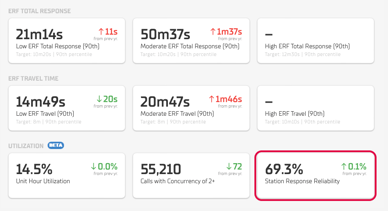
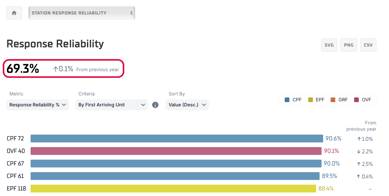
On the Station Response Reliability dashboard card, and at the top of the chart, you will find a top-line response reliability number for the agency as a whole, considering all incidents in all station response zones.
By default, response reliability is reported as a percentage. You can also select Reliable Responses from the Metric menu directly below the header to report the number of incidents successfully responded to. This setting affects the top-line number as well as the per-station chart.
Per-Station
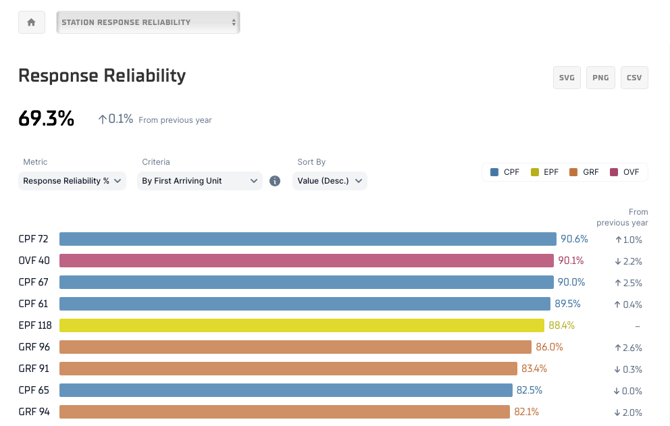
The station response reliability chart compares all agency stations by reliability percentage. Mutual aid stations belonging to other agencies are not included by default.
Use the Criteria menu to select your preferred definition of response reliability.
- By First Arriving Unit evaluates whether the station was able to send the first qualified unit to arrive at the incident.
- By Initially Dispatched Unit evaluates whether the station was available to respond to the initial dispatch with at least one qualified apparatus, whether or not that apparatus arrived on scene first.
Eligible Units
In order to be considered a reliable response, the station must dispatch a unit with appropriate response capabilities considering the type of incident. We refer to these as eligible units.